


A Roadmap for NYC to Follow

Cities around the world have already seen success endorsing the principles and adopting open source infrastructure. New York should join them.

Aerial view of the Barcelona skyline and Sagrada Família at dusk

Barcelona: The First City to Sign

On November 2, 2025, Barcelona became the first city in the world to formally endorse the UN Open Source Principles — a decision sparked by attending UN Open Source Week in New York, the event this campaign is built around. It paired the signature with three commitments still being built out: an Open Source Programme Office, a citizen agreement on digital rights, and a municipal open source fund. The signature itself was immediate — exactly the low-cost, high-signal move this campaign asks of New York.

The proof of concept was already running. Decidim, Barcelona’s open source participation platform, has operated since 2016; one participatory budgeting cycle allocated €30 million and drew 64,571 participants. In 2023 it was recognized as a Digital Public Good.

1stCity in the world to endorse the UN Principles
64,571Participants in one participatory-budget cycle
2023Decidim recognized as a UN-aligned Digital Public Good

New York is already inside this story: the city’s own Civic Engagement Commission runs its participatory budgeting on Decidim today. NYC didn’t have to build that tool — Barcelona built it and gave it away, as it did for Helsinki, Mexico City, France’s National Assembly, and the European Commission.

Sources: Barcelona City Council, Decidim, Digital Public Goods Alliance

Eiffel Tower and Paris rooftops at sunset

Paris: From One Office to National Policy

Paris has run an open source policy since 2002, centered on Lutèce — a platform that now powers more than 300 city services, from permits to the participatory budget. In 2022 it stood up Europe’s first city-level Open Source Programme Office, an office with real reach: a Baltimore neighborhood nonprofit piloted Lutèce with support from Paris’s own IT staff — one city’s software crossing an ocean because it was built to be reusable.

Then the model scaled. In May 2025, France became the first national government to endorse the UN Open Source Principles; its national catalog now lists 494 approved free software products used across 183 public bodies. One city’s OSPO became, within three years, whole-of-government infrastructure.

2022Paris’s OSPO founded — first in Europe
May 2025France, first national government to endorse
494Free software products in France’s official government catalog

For New York, the parallel is direct: being first isn’t a press moment, it’s a starting point other institutions build on.

Sources: Paris Open Source, OSPO++ Europe, Technical.ly, unite.un.org, code.gouv.fr

Tokyo Tower and skyline at sunset

Tokyo: When Transparency Becomes Infrastructure

In March 2020, with COVID-19 spreading and no time for normal procurement, the Tokyo Metropolitan Government worked with Code for Japan to build its COVID-19 dashboard entirely in the open on GitHub — public code anyone could inspect, question, or copy, built in weeks instead of months.

Every one of Japan’s 47 prefectures forked it rather than building their own. No national mandate required it — the code being open and well-built was enough. One city’s transparency became the country’s de facto standard for a public-health emergency.

47/47Japanese prefectures that adopted Tokyo’s dashboard
2020Built in the open, in weeks, during a live crisis
0National mandates needed to make it the standard

Sources: Tokyo-Metro-Gov/covid19 (GitHub), official fork registry

Governments Doing This Now

Cities and nations have run open source programs for years, increasingly sharing one codebase across dozens of governments instead of each buying its own.

Munich

"Public money, public code" as council policy

After a decade of hard-won lessons on desktop Linux, Munich came back smarter: a 2023 City Council motion created an OSPO with a dual mandate — use open source where it’s strong, and publish the city’s own software.

Lesson for NYCThe mature posture isn’t all-or-nothing migration — it’s an institutional office with a publish-by-default rule.

Learn more →


Estonia

Open sourcing the national data backbone

X-Road, the data exchange layer connecting Estonia’s entire digital state, was open sourced in 2016. Estonia and Finland federated their national systems in 2018, Iceland followed, and roughly 20 more countries now run it.

Lesson for NYCOpening core infrastructure turned one country’s backbone into a shared international standard with pooled maintenance.

Learn more →
Germany

Funding the open source that everything runs on

Germany’s Sovereign Tech Agency has invested over €24 million in 60+ critical open source components since 2022. Demand tells the story: nearly 500 applications seeking more than €114 million — several times what it could fund.

Lesson for NYCOpen infrastructure needs maintenance money, and a public fund for it is now a proven, exportable model.

Learn more →
India

DPI at population scale

India’s open digital rails for identity and payments process billions of transactions a month across hundreds of competing apps. MOSIP, the open source ID platform born of the same thinking, is now adopted across Asia and Africa.

Lesson for NYCWhen the rails are open and interoperable, the private sector competes on top of them instead of owning them.

Learn more →
DHIS2

Health data for 80+ countries, one codebase

DHIS2, stewarded by the University of Oslo, is the government health-information system of record in more than 80 countries, reaching roughly 3.2 billion people — ministries co-fund one shared platform instead of buying 80 separate ones.

Lesson for NYCPooled maintenance beats duplicated procurement, for decades at a stretch.

Learn more →
OpenCRVS

Civil registration, configured per country

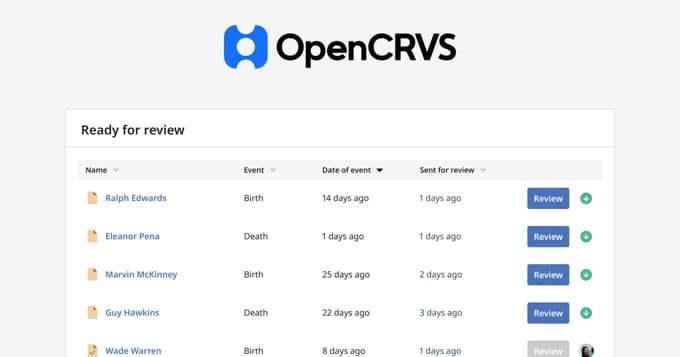
OpenCRVS is an open source birth-, death-, and marriage-registration platform built for multi-country adoption: configurable per nation’s laws, interoperable with identity, payments, and health systems.

Lesson for NYCFoundational systems can be built once as open standards and localized per jurisdiction — exactly the reusability NYC procurement could ask for.

Learn more →

Ready to add New York to this list?